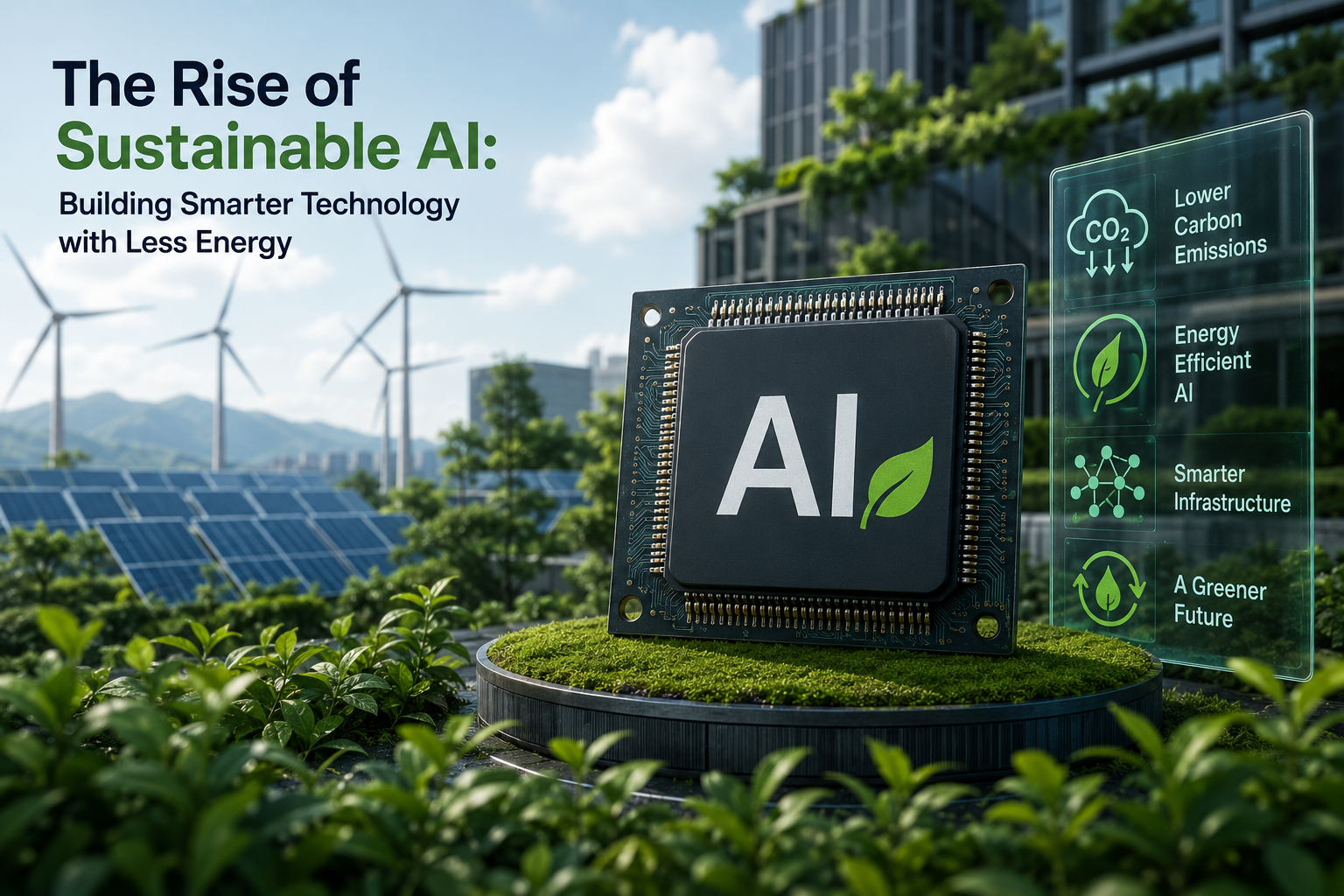
The Rise of Sustainable AI: Building Smarter Technology with Less Energy
For years, conversations about artificial intelligence have focused on what AI can do. Businesses have used it to automate tasks, improve customer experiences, accelerate decision-making, and unlock new revenue opportunities. Yet as AI adoption continues to grow, a different question is starting to gain attention:
How much energy does all of this innovation consume?
Sustainable AI has emerged as one of the most important discussions in technology today. As organizations race to deploy increasingly powerful AI systems, concerns about energy consumption, carbon emissions, and environmental impact are becoming impossible to ignore.
The challenge isn’t whether businesses should continue investing in artificial intelligence. The challenge is finding ways to innovate without creating unnecessary environmental costs.
Why Sustainable AI Matters More Than Ever
Every AI application relies on computing power.
Whether it’s a chatbot answering customer questions, a recommendation engine suggesting products, or a machine learning model analyzing financial data, massive amounts of information are being processed behind the scenes.
Most users never see the infrastructure that makes this possible. Hidden behind every AI-powered experience are data centers operating around the clock, consuming significant amounts of electricity to train and run increasingly sophisticated models.
As AI capabilities expand, so does the demand for computational resources.
This growing demand has forced technology leaders to think differently about how AI systems are designed, deployed, and maintained. Instead of focusing solely on performance, many organizations are now asking how they can achieve the same results using fewer resources.
That shift sits at the heart of Sustainable AI.
How Sustainable AI Reduces Environmental Impact
Creating environmentally responsible AI isn’t about slowing innovation. In many cases, it’s about building smarter systems.
Organizations are discovering that efficient AI models often deliver business benefits alongside environmental gains.
Sustainable AI Through Smarter Model Design
One of the most effective ways to reduce AI’s environmental impact is by improving the efficiency of the models themselves.
For years, there was a widespread belief that bigger models automatically produced better results. While larger models can be powerful, they also require more computing power, more storage, and more energy.
Today, many development teams are focusing on optimization rather than expansion.
By removing unnecessary parameters, simplifying architectures, and improving algorithm efficiency, businesses can often achieve comparable results while using significantly fewer resources.
The result is faster performance, lower infrastructure costs, and reduced energy consumption.
Building More Efficient Infrastructure
Infrastructure decisions also play a major role in sustainability.
Many technology companies are investing heavily in energy-efficient data centers, renewable energy sources, and advanced cooling technologies designed to reduce electricity consumption.
These investments are not driven purely by environmental concerns. They also make financial sense.
Lower energy usage reduces operating costs, creating a clear business incentive for organizations seeking to scale their AI operations responsibly.
Emerging Technologies Supporting Sustainable AI
Several emerging technologies are helping organizations reduce the environmental impact of artificial intelligence while maintaining high performance.
Edge Computing
Traditionally, much of AI processing has taken place in centralized cloud environments.
Edge computing changes that approach by moving processing closer to the source of the data.
Instead of sending every request to a distant server, devices can handle certain tasks locally. This reduces network traffic, lowers latency, and decreases the amount of energy required for data transmission.
The technology is already being used in connected vehicles, industrial automation systems, smart manufacturing, and Internet of Things (IoT) devices.
Federated Learning
Federated learning takes a different approach to efficiency.
Rather than collecting data from thousands of devices and sending it to a central server, models are trained locally and only learning updates are shared.
This method offers several advantages:
- Reduced data transfer requirements
- Lower network energy consumption
- Improved privacy protection
- Greater scalability
As privacy regulations continue to evolve worldwide, federated learning is becoming increasingly attractive for organizations seeking both sustainability and compliance.
Quantum Computing and the Road Ahead
Quantum computing remains an emerging field, but its potential impact on Sustainable AI is significant.
Researchers believe future quantum systems could solve specific computational problems much more efficiently than traditional computers.
While widespread commercial adoption is still some distance away, advances in quantum computing may eventually reduce the energy required for certain AI workloads and unlock entirely new possibilities for machine learning.
Business Benefits Beyond Sustainability
One misconception is that Sustainable AI is primarily an environmental initiative.
In reality, many organizations are pursuing sustainability because it delivers measurable business advantages.
Reduced Operating Costs
Energy efficiency often translates directly into lower operational expenses.
Organizations that optimize their AI infrastructure typically spend less on computing resources while maintaining performance levels.
Stronger Brand Reputation
Customers, investors, and stakeholders increasingly pay attention to how businesses approach sustainability.
Companies that demonstrate a genuine commitment to responsible technology development often strengthen trust and improve their competitive position.
Better Regulatory Preparedness
Governments around the world are introducing new regulations related to environmental reporting and emissions reduction.
Organizations that prioritize Sustainable AI today are likely to be better prepared for future compliance requirements.
Challenges Facing Sustainable AI Adoption
Although the benefits are clear, implementing Sustainable AI is not always straightforward.
Many organizations face pressure to deploy new AI capabilities quickly, leaving little time to evaluate long-term environmental impacts.
Common challenges include:
- Limited sustainability expertise within technical teams
- High upfront infrastructure investments
- Difficulty measuring environmental impact accurately
- Lack of industry-wide reporting standards
Addressing these challenges will require collaboration between technology companies, policymakers, researchers, and industry leaders.
What the Future of Sustainable AI Looks Like
The future of AI will almost certainly involve a greater focus on efficiency.
Researchers are developing more energy-efficient algorithms, hardware manufacturers are creating specialized AI chips, and organizations are beginning to include sustainability metrics in technology planning discussions.
At the same time, universities and training institutions are incorporating sustainability principles into technology and computer science programs, helping prepare the next generation of AI professionals.
What was once considered a niche concern is rapidly becoming a mainstream business priority.
Final Thoughts
Artificial intelligence has the potential to solve some of society’s most complex problems, but its long-term success will depend on how responsibly it is developed and deployed.
Sustainable AI offers a practical path forward. By focusing on efficient model design, smarter infrastructure, and emerging technologies such as edge computing and federated learning, organizations can continue innovating while reducing their environmental impact. The future of AI isn’t simply about building more powerful systems. It’s about building systems that are powerful, efficient, and sustainable enough to support innovation for years to come.




Post Comment