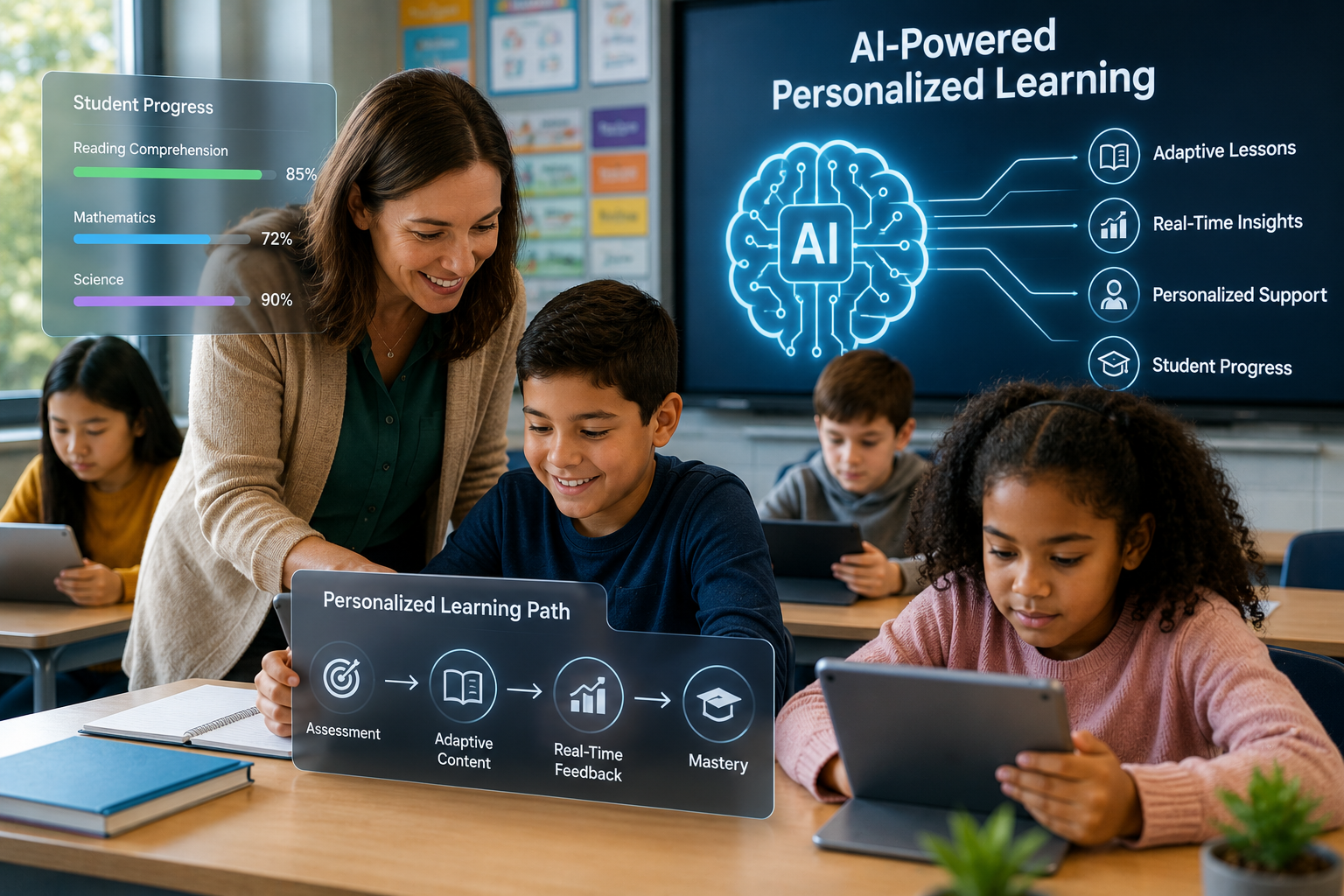
How AI-Powered Personalized Learning Is Closing Achievement Gaps in K-12 Education
Walk into almost any classroom and you’ll see something educators have been dealing with for generations: students learn differently.
Some students grasp new concepts almost immediately. Others need extra examples, more practice, or a different explanation before the lesson truly clicks. Yet despite these differences, most classrooms still operate within a system designed to teach large groups of students at the same pace.
For teachers, that creates an enormous challenge.
Move too quickly and some students struggle to keep up. Move too slowly and others become bored and disengaged.
This is where AI-powered personalized learning is beginning to make a meaningful difference.
Rather than delivering the same learning experience to every student, artificial intelligence allows educational platforms to adapt lessons based on an individual’s strengths, challenges, and progress. The result is a more flexible approach to education that helps students receive support when they need it most.
As schools continue searching for ways to improve outcomes and reduce educational inequality, many educators see AI as a practical tool that can help bridge long-standing achievement gaps.
Why Achievement Gaps Continue to Challenge Schools
Achievement gaps remain one of the most persistent challenges in education.
These gaps often appear when certain groups of students consistently perform below their peers in areas such as literacy, mathematics, graduation rates, or standardized assessments.
The reasons are rarely simple.
Factors such as socioeconomic circumstances, access to educational resources, learning difficulties, language barriers, and differences in home support can all influence academic performance.
Teachers work tirelessly to address these challenges, but they also face practical limitations. Large class sizes, administrative responsibilities, and limited instructional time can make it difficult to provide every student with the level of individual attention they need.
As a result, some learners fall behind while others fail to reach their full potential.
How AI-Powered Personalized Learning Works
At its core, AI-powered personalized learning uses data to understand how individual students learn.
Modern learning platforms can track a wide range of information, including:
- Topics a student has mastered
- Areas where additional support is needed
- Learning pace
- Assessment performance
- Engagement levels
- Study habits and learning patterns
The system continuously analyzes this information and adjusts learning content accordingly.
Instead of every student following exactly the same path, lessons can adapt based on individual progress.
For educators, this provides valuable insight into student needs without requiring hours of manual analysis.
AI-Powered Personalized Learning Creates Individual Learning Paths
One of the biggest advantages of AI in education is its ability to create personalized learning journeys.
Imagine two students studying the same mathematics topic.
One quickly demonstrates mastery and is ready for more advanced concepts. The other struggles with foundational principles and requires additional support before moving forward.
In a traditional classroom, meeting both needs simultaneously can be difficult.
With adaptive learning technology, each student can receive content tailored to their current level of understanding.
The advanced learner remains challenged while the struggling learner receives targeted support without feeling left behind.
This approach helps reduce frustration and creates a learning experience that feels more achievable for students at every stage.
Benefits for Students
The potential benefits of AI-powered personalized learning extend beyond academic performance.
Better Engagement
Students are more likely to stay motivated when lessons align with their abilities and interests.
When content feels either too difficult or too easy, engagement often drops. Personalized learning helps maintain the right balance by presenting challenges that are appropriate for each learner.
Increased Confidence
Confidence plays a significant role in educational success.
Students who experience repeated struggles can begin to doubt their abilities, while those who achieve small, consistent successes often become more willing to participate and take on new challenges.
By providing support at the right time, AI systems can help build confidence and encourage continued learning.
Improved Learning Outcomes
When learning gaps are identified early, teachers and students can address them before they become major obstacles.
This targeted support often leads to stronger academic performance and a deeper understanding of key concepts.
Benefits for Teachers
One of the most common misconceptions surrounding AI in education is that it aims to replace teachers.
In reality, the most effective educational technology is designed to support educators, not replace them.
Teachers remain responsible for instruction, mentorship, classroom culture, critical thinking development, and emotional support. These are areas where human interaction remains essential.
AI simply provides additional information that helps teachers make informed decisions.
Real-Time Insights for Better Support
Modern AI learning platforms can provide teachers with immediate visibility into student performance.
Instead of waiting until the end of a term to identify problems, educators can spot learning difficulties as they emerge.
This allows teachers to:
- Identify struggling students earlier
- Monitor progress more effectively
- Create targeted intervention strategies
- Allocate classroom time more efficiently
- Focus on meaningful student interactions
For many teachers, these insights are among the most valuable benefits of educational AI.
The UK’s Growing Role in Educational Innovation
The United Kingdom has become an increasingly important player in the global educational technology sector.
Government initiatives, universities, and private technology companies continue to invest in tools designed to improve teaching and learning outcomes.
The UK’s growing EdTech ecosystem has helped schools experiment with innovative approaches to personalized education, including adaptive learning platforms, intelligent assessment systems, and AI-powered tutoring solutions.
As educational technology continues to evolve, the UK is well positioned to contribute to many of the innovations shaping the future of learning.
Challenges Schools Must Address
Despite its promise, AI-powered learning is not without challenges.
Data Privacy and Security
Educational platforms collect significant amounts of student data.
Schools must ensure that information is stored securely, managed responsibly, and used in ways that protect student privacy.
Digital Access and Equity
Not every student has equal access to devices or reliable internet connectivity.
Without proper planning, technology initiatives risk widening existing inequalities rather than reducing them.
Algorithmic Bias
AI systems are only as effective as the data used to train them.
Developers and educational institutions must continuously evaluate systems to ensure that recommendations remain fair, accurate, and inclusive for all students.
The Future of AI in Education
The future of education is unlikely to be defined by technology alone.
Instead, it will be shaped by how effectively technology and educators work together.
As AI systems become more advanced, schools may gain access to better tools for identifying learning challenges, predicting academic risks, and supporting student development.
However, technology should remain a tool rather than the goal itself.
The most successful educational environments will continue to place teachers at the center while using AI to enhance learning experiences and expand opportunities for students.
Final Thoughts
Educational inequality remains one of the most complex challenges facing schools around the world.
While artificial intelligence is not a complete solution, AI-powered personalized learning offers a practical and scalable way to support diverse learning needs and improve student outcomes.
By combining the expertise of educators with the capabilities of intelligent technology, schools can create learning environments that are more responsive, inclusive, and effective.
As adoption continues to grow, AI may play an increasingly important role in helping every student receive the support they need to succeed.


Post Comment