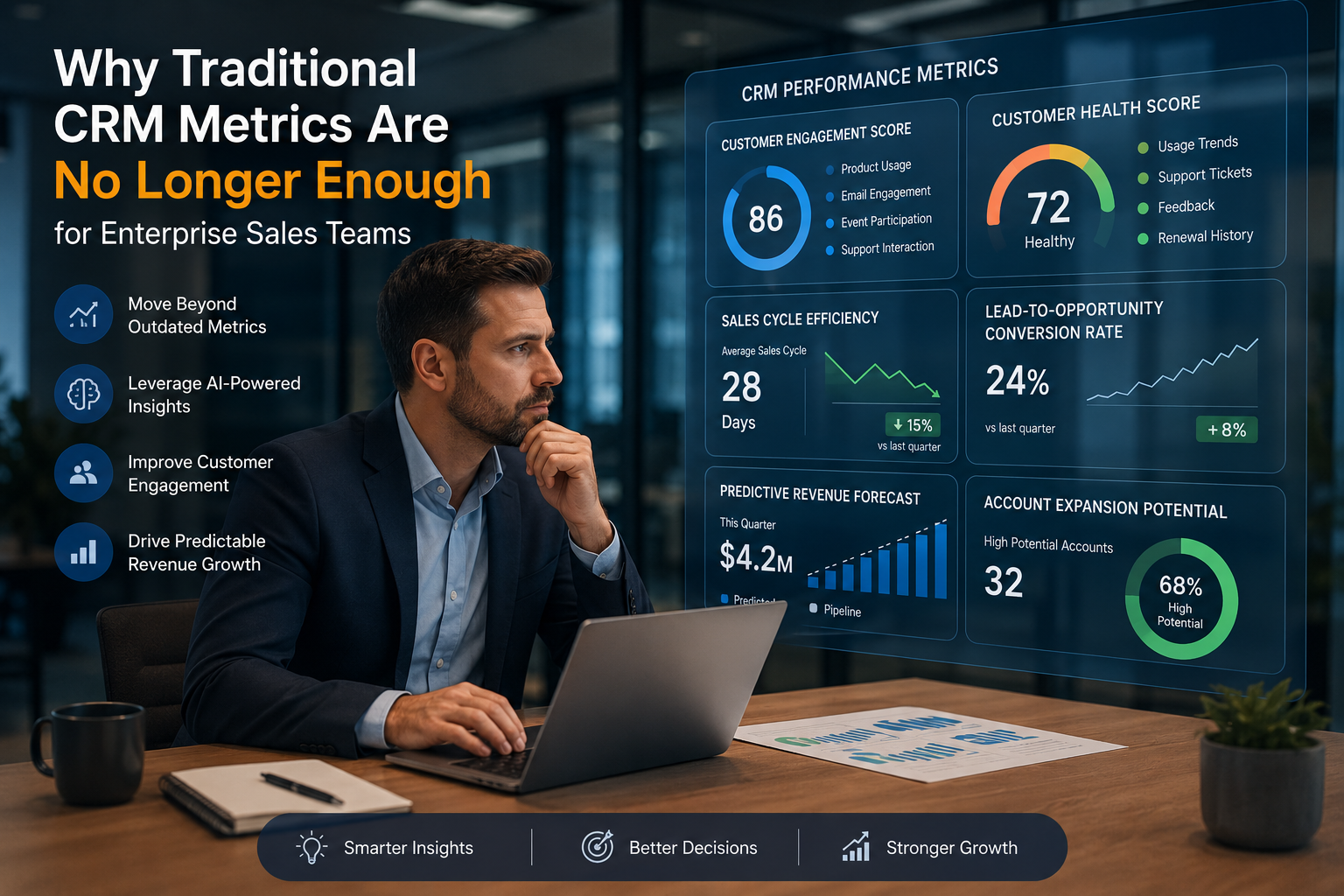
Why Traditional CRM Metrics Are No Longer Enough for Enterprise Sales Teams
CRM performance metrics have always played an important role in helping sales leaders understand what’s working and what isn’t. For years, businesses have relied on familiar numbers such as Monthly Recurring Revenue (MRR), Customer Acquisition Cost (CAC), churn rate, and Customer Lifetime Value (CLV) to measure success.
The problem is that enterprise sales has changed dramatically.
Buying decisions now involve more stakeholders, longer sales cycles, and multiple touchpoints across email, social media, webinars, product demos, and customer success teams. A deal can spend months moving through the pipeline before a decision is made.
In that environment, traditional metrics still matter, but they no longer tell the whole story.
Modern CRM platforms are evolving into intelligent business systems that do far more than store customer information. They’re helping organizations understand customer behavior, predict future outcomes, and uncover opportunities that would have been difficult to spot just a few years ago.
As a result, a new generation of CRM performance metrics is emerging, giving enterprise sales teams a much clearer picture of what’s really driving growth.
The Evolution of CRM Systems
There was a time when a CRM was little more than a digital contact database.
Sales teams used CRM software to record customer details, track conversations, and monitor deals moving through the pipeline. While useful, these systems were largely reactive. They captured information but offered very little guidance on what to do next.
Today’s CRM platforms are completely different.
Artificial intelligence, machine learning, predictive analytics, and automation have transformed CRM software into a strategic business tool. Modern platforms can identify patterns across thousands of customer interactions, highlight risks, recommend next actions, and even forecast revenue with surprising accuracy.
For sales leaders, this shift has opened the door to a more sophisticated way of measuring performance.
Why Traditional CRM Performance Metrics Have Limitations
Most businesses still track the usual SaaS metrics, and rightly so.
Revenue growth, customer acquisition costs, and retention rates remain important indicators of business health. However, they often provide a backward-looking view of performance.
For example, churn rate tells you how many customers you’ve lost. It doesn’t necessarily tell you which customers are likely to leave next month.
Revenue figures show what happened last quarter. They don’t always explain why certain opportunities succeeded while others failed.
This is where many enterprise organizations are beginning to rethink how they measure success.
Instead of focusing only on outcomes, they’re looking for metrics that help them understand customer intent, sales efficiency, and future growth opportunities.
New CRM Performance Metrics Transforming Enterprise Sales
Modern CRM systems are creating entirely new ways to evaluate customer relationships and sales performance.
Customer Engagement Score
One metric gaining significant attention is the Customer Engagement Score.
Rather than measuring revenue alone, this score evaluates how actively a customer interacts with a business.
It can include factors such as:
- Product usage frequency
- Email engagement
- Attendance at webinars or events
- Support ticket activity
- Meetings with account managers
- Feature adoption rates
A customer who regularly uses the product, engages with communications, and participates in training sessions is generally more valuable than one who simply pays an invoice each month.
Engagement often becomes an early indicator of retention and future growth.
Sales Cycle Efficiency
Many organizations focus heavily on closing deals but spend less time analyzing how efficiently those deals move through the pipeline.
Sales Cycle Efficiency measures the time spent at each stage of the sales process and helps identify bottlenecks that slow down revenue generation.
For example, if deals consistently stall during legal review or procurement discussions, leadership teams can investigate the cause and implement improvements.
Small efficiencies across the sales cycle can have a significant impact on overall business performance.
Lead-to-Opportunity Conversion Rate
Generating leads is rarely the difficult part.
The real challenge is turning those leads into qualified opportunities.
The Lead-to-Opportunity Conversion Rate provides insight into whether marketing and sales teams are attracting the right prospects and nurturing them effectively.
A business generating thousands of leads each month may appear successful on paper, but if very few of those leads become genuine opportunities, the underlying strategy may need adjustment.
How AI-Powered CRM Platforms Are Improving Forecasting
Forecasting has always been one of the most challenging aspects of enterprise sales.
Traditionally, forecasts relied heavily on the judgment and experience of individual sales representatives. While experience remains valuable, human forecasting is often influenced by optimism, assumptions, and incomplete information.
This is where AI-powered CRM platforms are making a noticeable difference.
Predictive Revenue Forecasting
Modern CRM systems can analyze historical deal data, customer behavior, buying patterns, and pipeline activity to produce more reliable forecasts.
Instead of relying solely on a salesperson’s confidence level, the system examines actual patterns across previous deals and identifies similarities.
For sales leaders, the benefits are practical and immediate.
Predictive forecasting helps answer questions such as:
- Which deals are most likely to close this quarter?
- Where resources should be allocated?
- Which opportunities are showing signs of risk?
- How realistic are current revenue targets?
The result is better planning, stronger decision-making, and fewer surprises at the end of the quarter.
Customer Health Scores Are Becoming Essential
Retaining customers has become just as important as acquiring them.
Many organizations now recognize that long-term growth often comes from strengthening existing relationships rather than constantly chasing new business.
This has led to the rise of Customer Health Scores.
CRM Performance Metrics That Predict Churn
A Customer Health Score combines multiple indicators into a single view of account health.
Common factors include:
- Product usage trends
- Customer support interactions
- Feedback and satisfaction scores
- Renewal history
- Communication frequency
- Account activity levels
When these indicators begin to decline, the CRM can flag potential risks before a customer formally decides to leave.
This gives customer success and account management teams an opportunity to step in early and address concerns before they become major issues.
Measuring Growth Beyond New Customer Acquisition
One of the biggest mistakes businesses make is assuming that growth must always come from new customers.
In reality, existing customers often present the most valuable opportunities.
Account Expansion Potential
Advanced CRM platforms can now identify accounts with strong expansion potential.
By analyzing usage patterns, purchasing behavior, and engagement data, businesses can identify customers who may benefit from additional services, upgrades, or complementary products.
This approach helps sales teams focus their efforts where they’re most likely to generate results.
It also creates a better customer experience because recommendations are based on genuine needs rather than aggressive sales tactics.
The Role of Automation in Modern Sales Analytics
One reason these new metrics have become possible is automation.
Without automation, sales teams would spend enormous amounts of time manually updating records, generating reports, and tracking customer interactions.
Modern CRM platforms handle much of this work automatically.
As a result, teams gain access to more accurate data while spending less time on administration.
The benefits are difficult to ignore:
- Improved reporting accuracy
- Faster access to insights
- Better visibility across the sales pipeline
- Reduced administrative burden
- More time spent engaging with customers
For many organizations, automation has become the foundation that makes advanced sales analytics possible.
Challenges Businesses Should Keep in Mind
Despite the advantages, adopting new CRM performance metrics isn’t always straightforward.
Data Quality Still Matters
Even the most sophisticated CRM platform is only as effective as the data it receives.
Incomplete records, duplicate accounts, and inconsistent processes can lead to unreliable insights.
Organizations that invest in data quality typically see better results from advanced analytics initiatives.
Too Many Metrics Can Create Confusion
Modern CRM systems can generate an overwhelming number of reports and dashboards.
The temptation is to track everything.
In practice, the most successful organizations focus on a handful of metrics that directly support their business goals.
More data does not automatically lead to better decisions.
Adoption Remains a Human Challenge
Technology is often the easy part.
Getting people to embrace new ways of working can be much harder.
Sales teams need to understand why these metrics matter and how they contribute to better outcomes. Without proper training and leadership support, even the most advanced CRM implementation can struggle to deliver value.
The Future of CRM Performance Metrics
CRM technology continues to evolve at a rapid pace.
Over the next few years, we can expect platforms to become even more predictive, proactive, and personalized.
Sales teams will increasingly rely on systems that can identify deal risks in real time, recommend next actions, detect customer sentiment, and highlight growth opportunities before they become obvious.
The shift is already underway.
Organizations that embrace these capabilities now will likely gain a significant advantage over competitors still relying solely on traditional performance indicators.
Final Thoughts
Enterprise sales has become too complex for traditional metrics alone.
While revenue, churn, and acquisition costs remain important, modern businesses need a deeper understanding of customer behavior, sales efficiency, and future growth potential.
The emergence of new CRM performance metrics is helping organizations move beyond basic reporting and toward genuinely actionable insights.
For sales leaders, the goal is no longer simply measuring what happened. It’s understanding what is happening now and what is likely to happen next. That shift may ultimately become the biggest advantage modern CRM platforms have to offer.



Post Comment