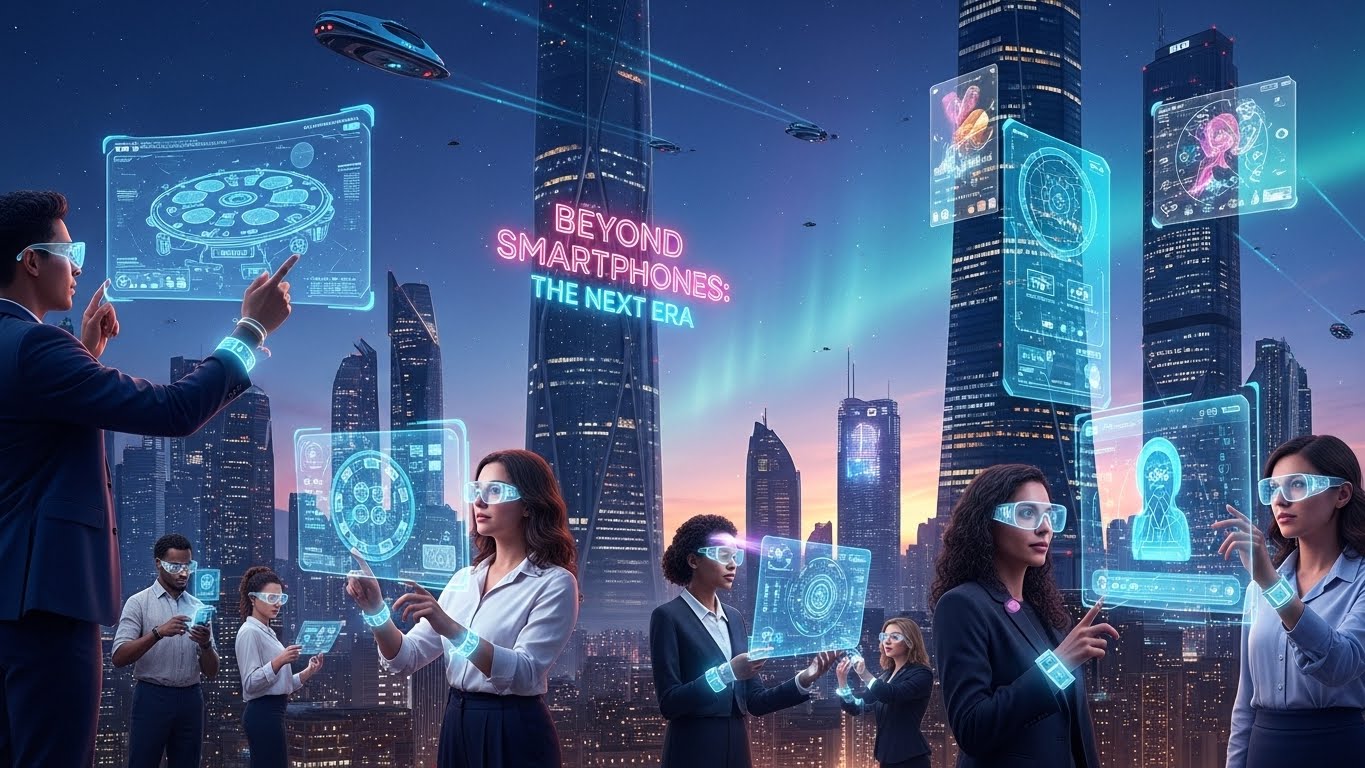
Tech Giants Envision Future Beyond Smartphones
For more than a decade, smartphones have been the center of our digital life. We use them for work, shopping, communication, entertainment, and even health tracking. But as we move beyond 2025, a big change is coming. Tech giants envision future beyond smartphones, where screens are no longer the main way we interact with technology.
Major companies like Apple, Google, Meta, Microsoft, OpenAI, and Neuralink are investing more than $150 billion into new technologies. These include augmented reality glasses, artificial intelligence companions, brain-computer interfaces, and ambient computing. The goal is simple. Make technology more natural, hands-free, and always available without holding a phone.
This blog explains why smartphones are reaching their limits, what will replace them, who is leading this change, and what challenges still exist.
Why the Smartphone Era Is Slowing Down
Smartphones are not disappearing tomorrow, but growth is slowing. Most people already own powerful phones, and yearly upgrades no longer feel exciting. Battery life, screen time fatigue, and privacy concerns are pushing users to look for better solutions.
Here Are the Main Reasons Why Tech Giants Envision Future Beyond Smartphones:
Market Saturation
The global smartphone market is crowded. Innovation has become small and repetitive. In 2024, investment in phone accessories dropped sharply, showing less interest in traditional mobile products.
Screen Fatigue
People spend many hours staring at screens. This causes eye strain, stress, and reduced focus. Users want technology that blends into life instead of demanding attention.
Demand for Hands-Free Tech
Surveys show that many users prefer hands-free devices that allow multitasking. Voice commands, smart glasses, and AI assistants feel more natural than tapping a screen.
Privacy Concerns
Phones collect massive amounts of personal data. New systems aim to reduce tracking by processing data locally and using context instead of constant input.
The Post-Smartphone Vision Explained
When tech giants talk about a future beyond smartphones, they are not talking about one device. They are talking about an ecosystem.
This future includes:
- Wearable AR glasses instead of screens
- AI that understands context and habits
- Devices that respond without commands
- Technology that works quietly in the background
This idea is often called ambient computing. Technology becomes part of the environment, not something you hold.
Experts believe this market could reach $3 trillion by 2030, making it one of the biggest technology shifts in history.
Timeline: How the Change Will Happen
2025 to 2026
- Affordable AR glasses enter the market
- Early brain-computer interface testing
- AI assistants become more proactive
2027 to 2028
- Mass adoption in workplaces
- AR replaces phones in navigation and tasks
- Ambient AI spreads in smart homes
2029 to 2030
- Hundreds of millions are using post-smartphone tech
- Smartphones become secondary devices
- Screenless computing becomes common
Key Companies Building the Future Beyond Smartphones
Meta: Leading with AR Glasses and AI
Meta has invested over $50 billion in AR and VR. Its smart glasses already allow photos, video, and AI interaction.
Upcoming AR glasses aim to:
- Show directions directly in your view
- Answer questions in real time
- Recognize objects and places
Meta wants smart glasses to do what smartphones once did, but without a screen in your hand.
Challenges include high cost and battery limits, but Meta believes mass adoption will solve these over time.
Neuralink: Connecting the Brain to Technology
Neuralink is working on brain-computer interfaces. These devices allow users to control technology using their thoughts.
Early results show:
- Paralyzed users controlling computers
- High accuracy in signal detection
- Strong interest in medical research
While this tech is still early, it shows how far beyond smartphones the future could go.
OpenAI: AI Everywhere Without a Screen
OpenAI is building ambient intelligence. This means AI that understands your environment and helps without being asked.
Examples include:
- AI is adjusting your workspace automatically
- AI is helping you complete tasks without apps
- Smart environments that react to behavior
The focus is on a zero learning curve. Users should not need to learn new tools.
Google: Open AR and AI Ecosystem
Google is creating an open system similar to Android. Its AR and AI efforts focus on compatibility across devices.
Key goals:
- Smart glasses with translation and navigation
- AI that understands voice and gestures
- Open tools for developers
Google believes open platforms will speed up adoption faster than closed systems.
Apple: Spatial Computing Instead of Phones
Apple is not killing the iPhone yet. Instead, it is slowly shifting toward spatial computing.
Apple’s strategy includes:
- Vision Pro mixed reality headset
- Lightweight AR glasses in development
- Deep integration with existing devices
Apple wants users to stay in its ecosystem while moving beyond phones naturally.
Microsoft: Mixed Reality for Workplaces
Microsoft focuses more on enterprise use. Its mixed reality tools help with training, design, and collaboration.
Key strengths:
- Holographic interfaces
- Cloud-powered AI
- Strong enterprise adoption
While less consumer-focused, Microsoft is shaping how future workplaces operate without phones.
Technologies Making This Future Possible
Advanced Display Systems
- Lightweight waveguide displays
- Contact lens displays under development
- Holographic projections
Smarter Processing
- On-device AI chips
- Faster edge computing
- Hybrid cloud systems
Better Power Solutions
- Solid-state batteries
- Wireless charging
- Energy harvesting from motion
These improvements make small, wearable devices powerful enough to replace phones.
Major Challenges Still Ahead
Even though tech giants envision a future beyond smartphones, several problems remain.
Privacy and Ethics
Many users worry about constant monitoring. Clear data rules and transparency are needed.
Battery Life
Wearable devices must last all day. Power efficiency is critical.
Social Acceptance
Some users feel uncomfortable wearing smart glasses. A better design is needed.
Security Risks
More connected devices mean more security challenges. Strong protection is essential.
What Consumers Really Want
Surveys show users want:
- Simple and reliable devices
- Clear benefits over smartphones
- Strong privacy controls
- Easy setup and usage
Technology must solve real problems, not just look futuristic.
Conclusion
The smartphone changed the world, but it is no longer the final stage of personal technology. Tech giants envision future beyond smartphones where computing is invisible, intelligent, and always available.
AR glasses, AI systems, brain interfaces, and ambient computing will slowly replace screens with experiences. This shift will take time, but the direction is clear.
The $3 trillion opportunity shows how serious this change is. As technology becomes more human-focused, the future will rely less on devices and more on seamless interaction.
The next era of computing is not about holding a phone. It is about living with technology naturally.
FAQs
What is the next big thing after smartphones?
AR glasses, ambient AI, and wearable computing are expected to replace smartphones.
What device will replace the smartphone?
No single device. A combination of smart glasses, AI assistants, and wearables.
Where will phones be in 10 years?
Phones will still exist, but will not be the main device.
What is the king of all phones?
Smartphones are being replaced by ecosystems, not one device.
Post Comment